
"Winning isn't everything; it's the only thing."
The God squad at the World Cup
Christians are asked to spread the Gospel, but are “I love Jesus” slogans or religious paraphernalia appropriate wear for football players?We are used to see Brazilian players removing their match shirts and displaying slogans such as “I belong to Jesus” or “Jesus loves you”. Wayne Rooney wearing a prominent Cross in training sessions aroused comments in the media. It is a common sight to see prayers – particularly from Latin America – making the sign of the Cross as they enter or leave the field.
Displaying T-shirts with religious slogans has been against FIFA policy for some time but in practice FIFA turned a blind eye to it. This year they have given notice that they will take a firm line
The FIFA policy stated on their website is an interpretation of Law 4: “It was agreed that at the World Cup, and at all football matches worldwide as from 1 July this year, undershirts must contain no messages of any kind, but be of only one plain colour”. Further clarification was given in a more explicit statement: “Players must not reveal undergarments showing slogans or advertising. The basic compulsory equipment must not have any political, religious or personal statements”.
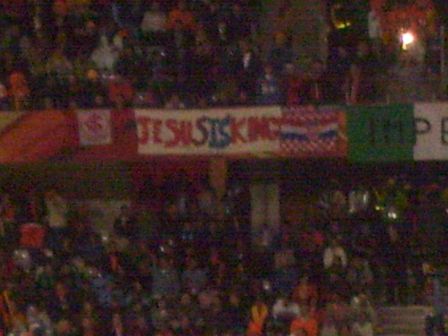
The policy also applies to spectators who can no longer hold up placards with John 3:16 on them (“For God so loved the world that he gave his one and only Son,[a] that whoever believes in him shall not perish but have eternal life”) – or in the case of Irish spectators’ reference to coach Jack Charlton in 1994 “Jack 3:16”.
The policy with regard to spectators is: “In addition, and in the interest of public safety, pieces of clothing or any accessories bearing inflammatory political or religious messages which are provocative and/or which can cause aggressive behaviour are prohibited”.
The source of this policy is “The FIFA Rights Protection Programme at the 2010 FIFA World Cup South Africa™” – a ironic title as some fans may feel that it takes away their rights rather than protecting them.
It is interesting to note that players are banned from any religious statements; spectators only from inflammatory religious messages.
It is not only evangelical Christians who use major sports events to advertise issues. In the last Africa Cup of Nations, an Egyptian player wore a T-shirt drawing attention to Palestine. In the Premiership a few years ago, Robbie Fowler, used a T-shirt to express support for the Liverpool dockers in an industrial dispute.
John Motson, the BBC football correspondent commented recently: “There are other ways to make your views known. I don’t think FIFA was taking an anti-religious view. There is a growing tendency for players to peel off their shirt and show whatever slogan happens to have grabbed them at the time. Now if a player revealed a T-shirt that was racist or abusive of another country, FIFA would be in an indefensible position. So I think they have had to introduce a blanket ban”.
I have heard people say that players are being denied a fundamental human right, that free speech is being denied. I find that argument hard to sustain. Sue Mott, the UK sports’ writer once remarked on Kaka’s “I belong to Jesus” T-shirt message “OK but tell him not me”.
In his recent book Onward Christian Athletes Tom Krattenmaker makes the point that sport has the ability to unite people while using a sports victory to promote a particular faith is inappropriate and potentially divisive.
Taking Superbowl winning coach Tony Dungy (Indiana Colts 2007) as an example Krattenmaker writes; “What Dungy is doing is taking an opportunity to unite people and turning it into a divisive moment. He should know better. When you’re in the stadium, and they re giving you the Super Bowl trophy, that’s a captive audience. That’s not the time to push your faith”
The argument by Evangelical Christians is that they are commanded by Jesus to go into all the world and preach the Gospel to every person. If you have the opportunity to play in a Superbowl or World Cup final you will have a live and TV audience given to few. Surely you must use it to spread the Gospel?
Isaiah 44:5 says “Some will say ‘I belong to the Lord’ others will call themselves by the name of Jacob; still others will write on their hand ‘The Lord’s’. And still others will write it on their T-shirts!
As a Christian I rejoice when sportspeople talk about Jesus. On the other hand I have always been a bit uncomfortable with this practice. To see players (as at the presentation of the 2002 World Cup to Brazil) wearing T-shirts with Christian slogans or match shirts with slogans written on them with marker pens, demeaned the occasion. I think it is also a fair question: if you take off the Nike shirt in the moment of its greatest exposure – for which Nike is paying you richly – should you give back the money?
I suggest that there is a time and a place to witness to your faith but a T-shirt at the World Cup is not it.
This article appeared in The Times. online edition in June 2010.